
Drupal · Acquia
Enterprise Drupal, engineered for scale.
Design Systems, Drupal and Acquia Site Studio working together to power high-traffic, mission-critical digital platforms.
We design, build and operate Drupal platforms for organizations that cannot afford downtime, inconsistency or improvisation.

The Problem
High-scale digital platforms fail for one reason: lack of engineering discipline.
Most enterprise websites collapse under growth. Not because of traffic, but because design, content and engineering were never aligned from the start.
Without a Design System, content becomes fragmented.
Without Drupal governance, scalability breaks.
Without Site Studio, marketing becomes dependent on development.
Our Approach
Engineering first. Always.
We don't sell templates. We architect platforms.
Code and Soul operates where failure is not an option:
- High traffic volumes
- Complex content ecosystems
- Multiple teams and stakeholders
- Continuous delivery under governance
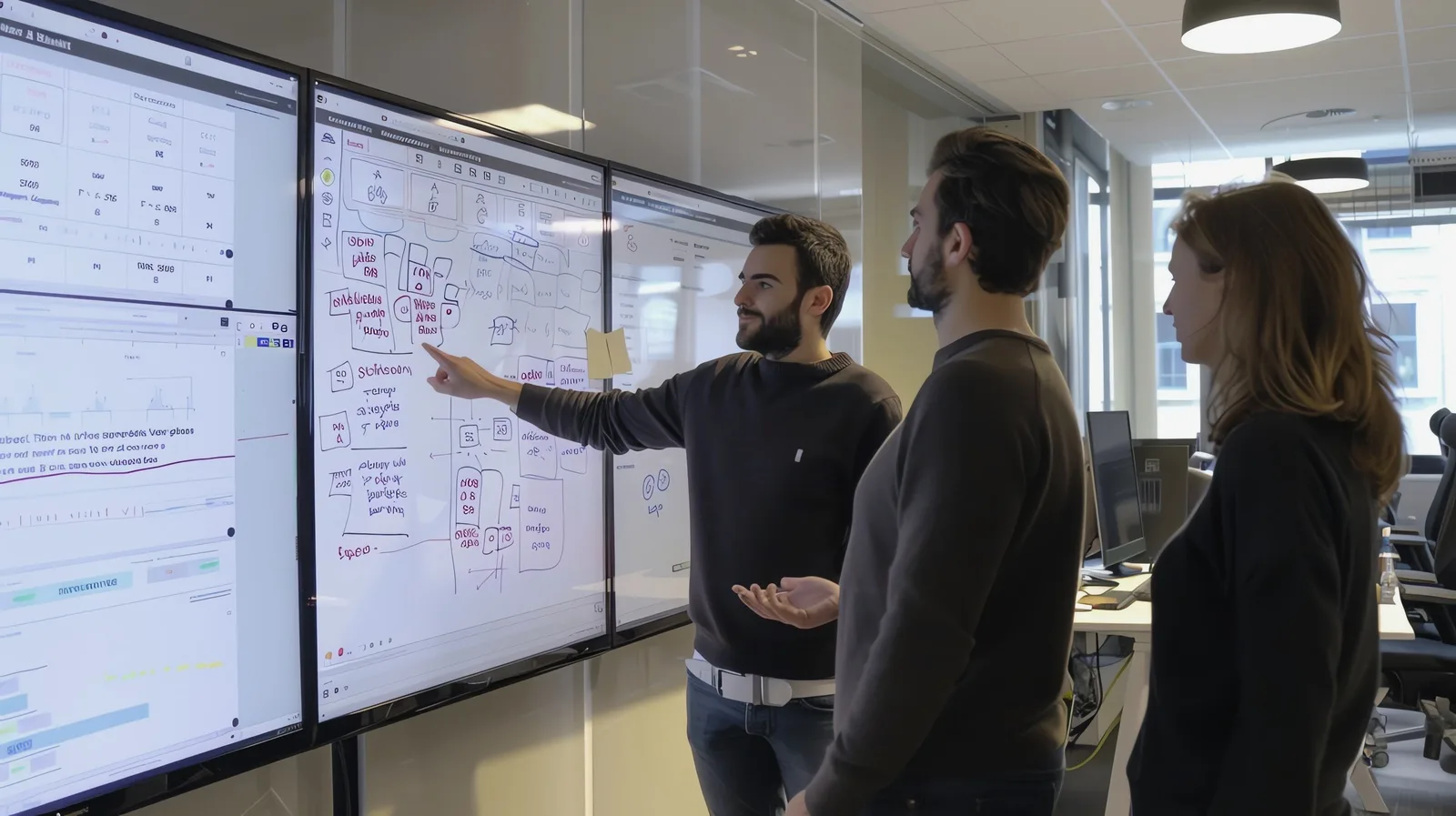
At enterprise scale, improvisation is expensive.
We are responsible not only for building, but for keeping platforms running, evolving and performing.
The three layers
Design System, Drupal and Site Studio are not three choices. They are three layers.
Each one governs something different, and the cost shows up when one tries to do the job of another.
- 01
Design Systems are not visual assets. They are operational infrastructure.
A Design System is the backbone of scalable digital platforms. We create Design Systems that:
- Align brand, UX and engineering
- Enable reuse without losing control
- Scale across teams, regions and products
- Reduce delivery time without sacrificing quality
- 02
Drupal is built for complexity. We make it predictable.
Drupal excels where other CMS platforms fail: complexity, governance and scale. Our Drupal implementations are designed for:
- Millions of monthly sessions
- Advanced content modeling
- Multi-site and multi-brand ecosystems
- Performance, security and compliance
- 03
Low-code without losing control.
Acquia Site Studio (Cohesion) transforms how marketing and engineering collaborate. With Site Studio:
- Marketing builds pages safely
- Design Systems remain intact
- Developers define rules, not layouts
- Velocity increases without chaos
The Difference
Most agencies deliver projects. We operate platforms.
- Official Acquia Partner
- Specialists in Design System + Drupal + Site Studio
- Proven experience with extremely high traffic environments
- Responsible for critical digital operations
- Engineering-led delivery, not marketing-led improvisation
Designed for high-volume environments and continuous operation.
Use Cases
Built for environments where uptime, consistency and speed are mandatory.
We operate platforms that support:
- National-scale digital portals
- Complex content governance
- Large editorial teams
- Continuous feature evolution
- Zero tolerance for instability

Integrations
Digital platforms don't live alone.
We connect Drupal to operational and data systems to build unified digital ecosystems.
When needed, we integrate Drupal platforms with ERP, CRM and operational systems such as Odoo, connecting content, data and business workflows into a single operational ecosystem.
Technology must serve the operation, not the other way around.
The decision
When Drupal is worth it, and when it is not.
Worth it when
- The operation is multi-site, multi-brand or multi-country, with real content governance
- Many people publish, with different permissions and an approval flow
- The content has to feed channels beyond the site
- Downtime and inconsistency carry a cost someone can actually calculate
Not worth it when
- The site has few pages and a small team publishing: Drupal charges you for complexity you will not use
- What you need is a campaign landing page in a matter of weeks
- Nobody is answerable for the platform after delivery, and the CMS would become debt with an interface
Drupal is not the right answer for every site. It is the right answer for a platform that has to last and change at the same time.
What people ask before deciding
- What is Acquia Site Studio?
- It is a visual building layer for Drupal where components are defined as versioned configuration rather than drawn freely on a canvas. Editors assemble pages from a component library that engineering defined; what is not in the library cannot be used. That restriction is the product: it is what lets you give the content team autonomy without the design system dissolving within six months.
- Are Site Studio and Cohesion the same thing?
- Yes. The product was called Cohesion DX8, was acquired by Acquia and renamed Acquia Site Studio. Older installations still carry the Cohesion name in modules, tables and internal documentation, which is why both words still appear together in search. If your base still says Cohesion somewhere, it is probably on a version worth reviewing before any further work.
- Does Drupal handle millions of visits?
- It does, and Drupal is rarely the bottleneck. At high volume what decides is the caching strategy and the database access pattern: cache tag granularity, BigPipe for what is dynamic per user, and a proxy or CDN in front that can invalidate without flushing everything. A platform that falls over at peak almost always has invalidation that is too coarse, not a CMS that is too weak.
- What is the difference between Drupal and Acquia?
- Drupal is the open source CMS; Acquia is a company selling hosting, tooling and Site Studio on top of it. Choosing Acquia is a decision about who owns operational responsibility, not about which CMS to use: Drupal is the same Drupal on any host. The useful question is not "Drupal or Acquia", it is how much of the operation you want in house.
- Is Drupal suitable for large enterprises?
- It is, and the reason is governance, not features. Drupal models permissions, editorial workflow, revisions and translation as first class structure, which matters when dozens of people publish across countries with different responsibilities. In small operations that is overhead; in large ones it is exactly what simpler CMSs lack.
- When does Site Studio get in the way?
- When it is treated as a page builder. If every campaign earns a new component, the library becomes a warehouse, the design system stops being verifiable, and maintenance cost comes back worse than before. What works is treating the component library as the rendered form of the design system, with the same review that code gets.
- Do you do headless Drupal?
- We do, and the question before that is whether it pays off. Headless separates content from presentation and earns that complexity when more than one consumer uses the same content: site, app, kiosk, partner. With a single consumer it usually costs more than it delivers.
- Can we run several sites on the same base?
- Yes, and that is either multisite or a shared design system, which are different things. Multisite splits the codebase and separates the database; a shared design system keeps one site with reused themes and components. The choice changes the cost of operating for years, not of building.
- What is a custom module, and when is it worth it?
- It is your own code extending Drupal where the out-of-the-box answer does not fit: an integration, a business rule, a content type with its own behaviour. It is worth it when the alternative is bending a third-party module until it breaks on the next update.
A real design system has numbers. A component library has a catalogue.
- 479
- components in the design system
- 675
- templates built on top of them
- 3.172
- canvases assembled in production
- 49
- custom modules in production, of 79 built
- 18
- editors publishing without raising a ticket, in 90 days
- 9.028
- content revisions in those same 90 days
Measured in the database of a large-scale corporate platform we operate. No client name and no sector: design-system scale does not identify a company, which is why these figures can be published while others from the same project cannot and are not.
Where this has run
The offer above has proof, and the proof has an address.
Tell us what your platform has to withstand.
Version migration, Site Studio, design system, or a Drupal that outgrew its architecture.
Engineering is not decoration. It is direction.